9.16.2008

Volvo XC70 Review


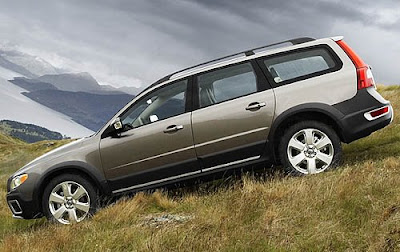
Timing is everything. Eight or nine years ago, Volvo took their V70 station wagon, added all-wheel drive and called it the "Cross Country". Sales were modest.

So about five years ago, Volvo whipped up a bigger crossover SUV on the S80 sedan platform and called it the XC90. Sales were much stronger, thank you.

Now, though, fluctuating gas prices have a lot of drivers thinking bigger is not necessarily better. Just in time, Volvo brings us...the Cross Country...but now it's called the XC70.

Frankly, it's a great move...bolstering a strong product with an association to the popular XC90. The XC70 is everything a Volvo wagon should be...strong, safe, rugged...and stylish inside. They haven't caught Audi yet, but Volvo interiors are among the best in the business.

Lower to the ground and lighter in weight, the XC70 handles better than the XC90 and gets better gas mileage, too (the EPA says 15 city, 22 highway). $36,775 is the base price. Our tester added metallic paint, a premium 12-speaker, Dolby ProLogic II surround sound system with AM, FM, CD and Sirius satellite radio, a Premium Package with a moonroof, leather, real wood inlays, a cold climate pakcage and alloy wheels, driving the bottom line up to $44,065.

Cheap? Only in comparison to a similarly loaded XC90 or other vehicle in its class. But if you don't need the extra weight and bulk of the XC90...the XC70 seems just right.

9.11.2008

Chevrolet Tahoe Hybrid Review


Would a 38 percent increase in fuel economy put a full-size SUV back on your shopping list? Chevrolet is hoping the answer is yes, because that's what they've done with the Tahoe Hybrid.

Putting a gasoline/electric hybrid system under the hood of the Tahoe runs the EPA estimated gas mileage up to 21 city/22 highway. Hybrids' ability to run on purely electric power at low speeds and to shut off at stoplights and in drive-throughs means bigger gains in city driving than on the open road.

Driving the Tahoe Hybrid is like driving any other Tahoe...very pleasant...made more so by the fact the gas gauge is taking a lot longer to move off of "F"...and by the silent running on pure electric power in parking lots and slow-moving traffic.

My only objection was a cosmetic one...the test vehicle came with no fewer than nine "Hybrid" badges...including three huge tape graphics (across the top of the windshield and along the bottom edge of each side). The week we had it, I took it to a church picnic, where one of my friends, a senior GM engineer, just smiled and said "Marketing."

Admittedly, those badges might reduce the dirty looks in the Whole Foods parking lot, but I bet three of them would work just as well as nine.

The main thing about the Tahoe Hybrid is that it's a first...the first full-size hybrid SUV. Hybrids need to move beyond compact cars to be profitable for the automakers and helpful to the environment. The Tahoe Hybrid is a terrific example for every automaker to follow.

Subaru Impreza 2.5GT Review


Somewhere out there, there must be a group of drivers for whom the Subaru Impreza is too mild and the Subaru Impreza WRX too wild...because Subaru has just split the difference with the new Impreza 2.5GT.

The 2.5GT looks like the rally-inspired WRX...but instead of the 265 horsepower turbocharged intercooled engine mated to a 5-speed manual, it comes with a 224 horsepower turbocharged intercooled engine coupled with a 4-speed automatic. Now, before you start bemoaning the loss of those 41 horses, that's actually the same power output as the '08 WRX...so the WRX gets a big boost and the 2.5GT moves in to take its place, at least as far as horsepower is concerned.

The 2.5GT uses a different all-wheel drive system than the WRX, and has less agressive suspension elements and tires. Still, 224 horsepower in something as relatively small and light as a Subaru Impreza is nothing to take lightly. If Subaru hadn't upgraded the WRX for the performance purists, the 2.5GT would be one of the hottest compacts around. As it is, it's a great blend of performance and comfort.

Audi Q7 Review


Don't like a certain vehicle after a test drive? Try one with a smaller engine.

Now, that may seem all wrong (especially coming from a car guy), but every now and then, the weight of the bigger engine goofs up the handling just enough to make the extra power anything from unpleasant to unusable.

Case in point: The Audi Q7. The first one of these I drove about a year and a half ago had the V8 engine...I couldn't put my finger on it, but there was something about it that was just....un-Audilike.

A recent week in the 3.6-liter V6 made it clear...it was the handling. See, the Q7 is a big SUV (based on the same platform as the Volkswagen Touraeg and Porsche Cayenne). Getting decent handling out of something this size is a neat trick to begin with. Put all that weight on the nose, and it's no help. But going for the V6 restores some balance...the Q7 is much more responsive and more fun to drive.

Of course, in the Q7, settling for the six isn't really settling. It puts out 280 horsepower and the 6-speed automatic transmission with Tiptronic and Dynamic Shift Program does a great job of getting the most out of it all. And gas mileage is better, too, with the EPA estimating 14 city and 20 highway miles per gallon.

The base price of $48,300 for the Q7 3.6 Premium includes 18-inch alloy wheels, automatic dual-zone climate control, an 11-speaker audio system, a third row of seats and a whole lot more. Our tester had the S-Line Sport Package (the cosmetic goodies from Audi's hot S models), which added 21-inch wheels, a three-spoke steering wheel, and some trim upgrades for $3,750. It also had the Technology Package (including Voice Control and DVD Navigation) and the Convenience Package (Xenon Plus headlights, and an upgrade to Bose audio)...all of which pushed the bottom line by nearly 10 grand...to $58,225.

That's a lot of money, but the usual Audi attributes make a strong argument...and the V6's combination of better balance and better mileage would be the way we'd go if it was our money.

9.09.2008

Audi TT Roadster Review


Sleek.

What was once a study in half-circles is now a lithe, svelte machine that oozes grace well beyond its small size.

The redesign of the Audi TT makes the coupe look better, too...but the true impact is on the roadster. Put the top down on one of these and just see if the restaurant valet can bring himself to do anything other than leave it up front where it looks so good.

There's a lot in the way of performance to recommend the TT roadster, too. No, it's not a fire-breathing monster, but 200 horsepower in a fairly light body mated to a six-speed automatic is way more than adequate...and returns better than average economy. The EPA says the TT roadster will get 22 miles per gallon in the city, 29 on the highway.

And it's a fine piece as it comes stock...automatic air conditioning, a 9-speaker, 140 watt audio system with CD player, cruise control, and a bunch more standard for $36,800.

Where it can get tricky is the option list. Our tester came with an additional $9,500 worth of leather, audio upgrades, a power folding top, navigation and more ($450 for Bluetooth phone preparation?)...tab that up with the $775 destination charge and the bottom line ended up at $47,075. Ouch.

Exercise some restraint, though, and the TT roadster makes a very good case for itself as a reasonably-priced sports car that looks great, gets good gas mileage and has more performance capability than you'll probably ever need.

Pontiac G8 Review


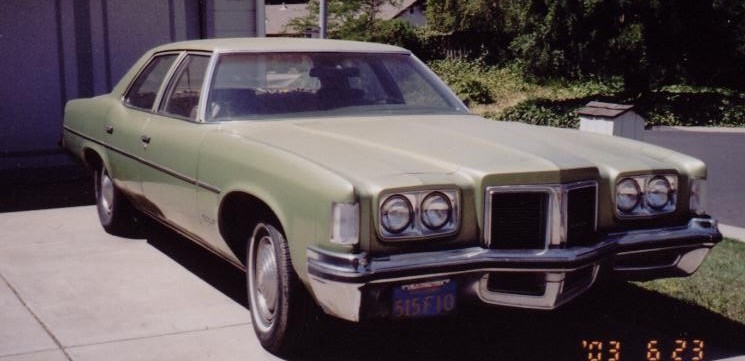
My driver's ed car in high school was a big Pontiac sedan...a 1972 Catalina...with a 455-cubic inch V8 engine. Just perfect for three not-yet-licensed 15 and a half year olds and a teacher with what may have been narcolepsy. Mr. Walkup's snore (usually about 20 minutes into the 90-minute class) was the signal to my best friend and myself (the third student was an exceptionally timid girl) to bury our right feet to the floorboards on the wide-open stretches of U.S. 395 between Bishop and Mammoth Lakes, California.

That was probably the last big Pontiac you could do that in and have any fun. Emissions regulations, insurance surcharges and the Arab oil embargo of 1973 all conspired to end the horsepower party soon afterward. Later attempts to recapture a performance image usually involved red cockpit lighting and ill-advised amounts of plastic body cladding, but, as so many have pointed out over the years...there's no substitute for cubic inches.

Well, even Pontiac doesn't measure 'em in cubic inches anymore, but the 6-liter V8 (roughly 366 CID) under the hood of the Pontiac G8 will do just fine. It's 361 horsepower in a car that manages to keep its curb weight just five pounds shy of two tons. Plant your right foot in the G8 and it moves right now...with a solidity, assurance and handling capabilities GM couldn't have imagined in '72.

And while the Driver's Ed Car of Doom would have looked right at home in Grandma's driveway (white, with a blue vinyl interior), the G8 announces its high-performance intentions the second you see it. It's a taut, muscular look that some writers have compared favorably with BMW.

Like the not-quite-there GTO of a couple of years back, this Pontiac is actually an Australian Holden rebadged for U.S. consumption. The good news in that deal is that Australians never gave up building hot sedans, and that the G8 interior is way different from...and way better than...anything else GM sells stateside.

The really good news is price...the G8 GT starts at $29,995 and our tester, loaded with a premium package that includes leather, power and heated seats, topped out at $31,395...a bargain bottom line. It's ironic that the re-birth of the big American performance sedan comes from Australia, but after a 35-year drought, we're not asking questions. Go drive one.

Volkswagen Passat Station Wagon Review


Forget who killed the electric car. Who killed the American station wagon (my vote is the movie National Lampoon's Vacation and its four-wheeled co-star, an early-80s Ford Country Squire that looked like the J.C. Whitney Parts warehouse exploded around it)?

Whoever it was, it drove us into the arms of the minivan and the SUV. And now with the minivan considered as uncool as wagons ever were and gasoline credit card bills prompting re-evaluations of the wisdom of SUV ownership, a lot of smart drivers are saying "What we need is a....station wagon".

Fortunately, the Europeans (who also didn't abandon the utilitarian hatchback the way we did here in the States) never stopped making them...which means you get all the goodness of the basic station wagon concept...and about 25 years additional research and development in the Volkswagen Passat wagon.

Part with a sum this side of 30-thousand dollars and you get an efficient, well-built, refined vehicle just like the Passat sedan...but with room to carry stuff...lots of stuff...in the back. Better looking than a minivan, better handling too. And way better gas mileage than most SUVs, including crossovers.

Truth be told, a station wagon is a much better choice for a majority of minivan and SUV buyers...and the Passat is at or near the top of the class.

(test vehicle provided by Camelback Volkswagen)

9.04.2008

Honda Accord Coupe Review


I've got a friend I've known for 21 years. We've always talked cars, as most guys do (especially, I guess, when one of the guys writes about them). He's owned classic Chevys from the 1940s, a couple of 70s and 80s Mazda RX-7s and most recently has been the owner (along with his wife) of his-n-hers Lexuses.

So imagine my surprise when he said "You know what I really want? The new Accord." I must've looked stunned, because he quickly added "The coupe. It's really hot-looking."

Now understand: I've been recommending Hondas in general and Accords in particular to friends for about 25 years now. It's my standard "you can't go wrong" recommendation. It's the car I recommended to my own mother. She took my advice and owned the same one for the final 17 years of her life. It's now in the posession of some of our dearest friends, whose teenage son and daughter are driving it. It shares the driveway with two Honda Odysseys, both the end result of conversations that began with "Mike, what kind of car should we buy?"

But this guy doesn't fit the profile at all. Or so I thought. Turns out he had seen the new Accord Coupe in person while I'd only seen photos. And the photos don't do it justice. This is way more than just a two-door version of the Accord sedan. It has a stunning visual presence...and the performance and features to back it up.

Performance first: A 3.5 liter SOHC 24-Valve VTEC V6 makes 268 horsepower. The EXL we tested comes with a 6-speed manual transmission standard, and Honda had the good sense not to check the automatic option box for this particular press fleet car. Honda has long made wonderful, precise stick shifts (some automakers' units still suffer in comparison to the four-speed in the '84 Civic that I put 144,000 miles on over 14 years before handing it off to the same friends who have Mom's old Accord). If anything, it's silkier than ever.

Features? Well, the EXL V6's $28,310 base price buys leather, a 270-watt AM/FM/mp3-capable 6-CD changer and a premium audio system with 7 speakers. Oh, yeah...XM Satellite Radio, too. Plus 18" alloy wheels, power everything and a moonroof. All standard. In fact, our tester had no options...add in $635 for destination and handling and the bottom line for this killer package was $28,945.

My friend was right. Line the new Accord Coupe up against anything else with this kind of performance and content, and the Accord looks better and better.

Range Rover Sport Review


Lusting after a Range Rover but can't quite swing the $80,000 (typically equipped) price tag?

How about a near look-alike that lets you keep $20,000 in the bank? The Range Rover Sport is actually based on the mid-size (for Land Rover, anyway) LR3, but re-bodied to look like the big Range Rover. Unless you're especially observant (a few inches missing from the overall length and a less-upright rear window are the biggest giveaways), you've probably looked at Sports and thought they were the flagship.

On the inside, Land Rover has created an ambiance that suggests you're not settling for less...and an extra $3,000 buys still more...the Luxury Interior Package with premium leather seats (heated front and rear), a heated front wind screen (the UK term for windshield), heated washer jets, adaptive front lamps, wood trim and a cooler box.

The "sport" part comes from the more compact dimensions and a 300 horsepower V8, with 315 pounds per foot of torque.

The base price of $58,225 (for a Range Rover Sport HSE) buys you a list of standard equipment that could cause a Blogspot server overload, so we'll just cut to the chase by saying that our tester had only two options...the Luxury Interior Package and Sirius Satellite Radio. Those, plus transportation, ran the bottom line to $62,400...again, about 20 large less than the large Range Rover.

Bottom line: Despite the savings, the Range Rover Sport isn't a cheap knockoff..it's simply a different approach to the real deal...and well worth your consideration.